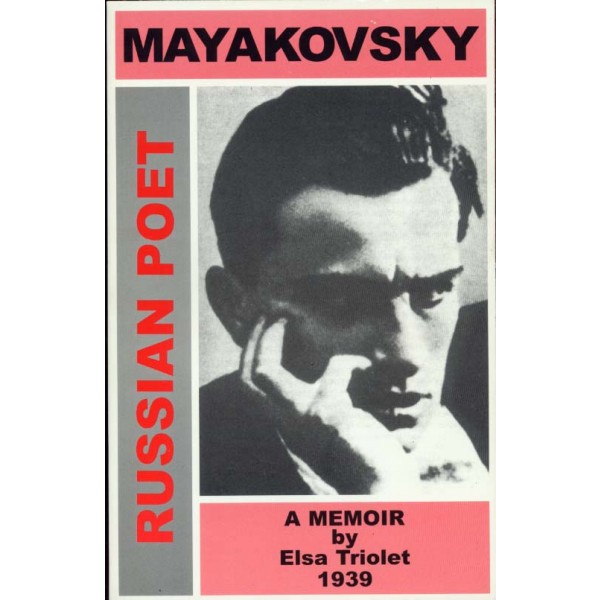
This lively little memoir by Elsa Triolet is a vivid and affectionate portrait of her de facto brother-in-law. I found it in the British library (in French) when I was researching a film script about the great Russian poet, Vladimir Mayakovsky, and decided to translate it.
Triolet was herself in love with Mayakovsky when she was a teenager, but he fell for her older sister, Lili, who was married to Osip Brik.
The inconvenience of Lili’s marital status did not deter Mayakovsky; he became great friends with husband, Osip Brik, and the three of them lived together in a menage a trois until Mayakovsky’s untimely death at his own hand, aged just 36.
Irina Padva interpreted the original Russian poetry to me, enabling me to present versions, in English, of the extracts Triolet has translated into French. (Triolet was married to Louis Aragon and wrote several novels in her adopted tongue).
The late John Rety (Hearing Eye) agreed to publish my translation and his partner, Susan Johns, spent many days patiently going through the text with me. This was the first book I ever published and the process taught me much. And so I am very grateful to John and Sue and commend this book – which can be purchased on this site – to the reader.
This film was shot in Hastings and is based on a series of 1921/2 DaDa manifestos by the Paris DaDa-ists. I will be posting the manifestos as texts in my translations from the French over the next few days.
When I first started spending time in Hastings, I had a lovely black Labrador, Iggy, who was not exactly tough. The dogs of Hastings, however, were.
In fact – to tangentialize for a brief moment – just a couple of months ago three staffies off the leash went nuts in St Leonards and hospitalized twelve people.
Anyway, Iggy… I was walking by the playground on West Hill with her and let her off the leash for her customary tear about. After about two minutes I heard this thigh-squeezing yelping and she returns staggering up the hill with two staffie pups attached to her throat. Seriously.
The owner, having difficulty herself making it up the hill, due to her excellent McCurves, arrived just as I managed to prise apart the second set of mini jaws from poor, trembling, Iggy’s neck.
I imagined she was going to apologize and decided not to make a fuss. This was not, however, the message this buxom youngster wished to deliver.
‘They’ve never done that before,’ she said, accusingly, snatching the two beasts up into the tender shelter of her weighty upper arms. She cast a vengeful look at Iggy: ‘Your dog must have done something,’ she shot, turning to sail back down the hill.
It’s quite amazing how owners of vicious-looking dogs are so defensive. ‘He’d never hurt a fly,’ they say fondly of some slavering beast straining at the leash with blood-red eyes, gnashing at the void.
Now, yesterday, it was sunny here in Funchal and we took a walk along the promenade where a canine obedience training session was underway. Two guys dressed up like police with black clothes and pocketed waistcoats were herding a bunch of dog owners and their best friends around inside a fenced off area. They told them to line up in a row, dogs sitting obediently by masters’ sides, facing out to sea.
We stopped to compare the relative attractiveness of each canine. One in particular caught our eyes – a lovely, medium-sized, collie type fluffy brown dog with a foxy tail. There was an assortment of about eight dogs, a little lap dog, a Labrador pup which kept getting up and pottering around, not very obediently, and…right at a the end of the line, a huge rottweiler.
The obedience task at hand was for the owner of each dog in turn to walk it on the leash, in and out of the line of other dogs. The very worthy aim of this exercise was to stop the dog doing that really irritating stopping and sniffing at every meeting with a fellow four-legger.
A nice, well-behaved white poodle went first, led by a pony-tailed teenage girl in jeggings and a little pink top. All went well until they tentatively approached the Rottie at the end. A distinct growling was heard and the Rottie’s owner, a dapper little man with a Hercule Poirot moustache, gave Rottie’s leash a yank by way of reprimand. The Rottie stayed seated, contenting itself with giving the white pooch a dirty look and the girl and her charge circled round and skipped off, relieved, on the home run.
‘Ah, dear Rottie,’ I said fondly and we resumed our walk. ‘They’re probably fine when they’re properly trained’. Suddenly a terrible fracas broke out and the air was filled with ferocious barking and yelping. We turned back to see the Rottie in mid air with the foxy tail of our favourite brown dog clamped firmly between his jaws; poor brown dog, still attached, was being whirled around like a toy.
The policeman-like trainer grabbed the Rottie and prised open its jaws, delivering the bloodstained victim back into its owner’s hands. Now he had to prove dominion over the huge powerful beast which was baring its teeth and facing him off. With some kind of super-human strength he hurled it onto its back and, placing a knee on its chest, kept it pinned down while it struggled and growled.
The Rottie eventually surrendered, and the assistant trainer brought over a muzzle which was buckled over its throbbing jaws. The leash was tightened and the beast allowed to stand up and brush himself down. He was then returned to his owner. Now the trainer suggested the brown dog and the Rottie should be brought together again, presumably thinking the Rottie, having been subdued by man, would now be more docile.
Wrong! Once again as the brown dog tentatively approached he went beserk and nearly succeeded in breaking free from his diminutive owner’s grip, gnashing wildly despite the confines of the muzzle, eyes filled with pure hatred and violence.
Now the trainer brought an electronic device on a collar which was fastened around the psychopathic beast’s neck. Again, the two dogs were asked to approach, again Rottie went nuts…but this time he got an electric shock delivered by a complementary device in the trainer’s pocket.
The procedure was repeated until the Rottie’s frenzy upon meeting the other dog was slightly diminished as he tired of repeated electric shocks; now he retreated, skulking and growling, by his owner’s side.
The class ended and Rottie and his moustachio’d owner, along with all the other dogs and humans, dispersed. We fell into conversation with Rottie’s owner; he spoke excellent English and explained how the electric shock discipline device worked… and then came the proof that dogs and owners are the same the world over.
‘He’s usually so gentle,’ he said, patting Rottie’s chunky cranium. ‘He’s so good with children and he sits so quietly in the back of the car….’. As we gaped with horror at the idea of Rottie being anywhere near a child, Poirot turned to look accusingly at the poor brown dog, which still appeared completely traumatized by its ordeal. ‘There’s just something about that brown dog…’ he said.
Perhaps the post-revolutionary period in the so-called ‘Arab Spring’ countries is not as disappointing as it appears. Maybe the liberty that inspired thousands to shed their blood is still within reach; perhaps these countries, unused to freedom, will eventually tailor-make a form of freedom acceptable to all and encompassing the unique combination of values (religious, cultural, sectarian and ethnic) on which these ancient lands (artificially divided) are founded.
Or is there, perhaps, some truth in Machiavelli’s proposition from ‘The Prince’ that, ‘when countries are accustomed to live under a prince, and his family is exterminated, they, being on the one hand accustomed to obey and on the other hand not having the old prince, cannot agree on making one from among themselves, and they do not know how to govern themselves’.
Failure to achieve national unity, political inexperience and polarization of extreme views (formerly prohibited) characterize the post-revolutionary landscape in Tunisia and Egypt and, to a much greater extent in Libya where the ‘Prince’ figure (Gaddafi) was even more pervasive in the national psyche.
In Syria, too, the disunity of the various opposition factions impedes victory and increases the chances of the ‘Prince’ retaining power despite breaking all humanitarian values and expectations. Even when a foreign power intercedes, as Machiavelli points out, it is invariably in order to add the client state to its own empire.
It was an uncomfortable moment, looking round the vast and shiny hotel lobby and realizing my clothing and demeanour so closely resembled that of our fellow inmates in this island hotel. Shorts, socks, trainers, check, t-shirt, check, and some kind of outerwear, hooded sweatshirt or anorak, check. White hair? Not yet, but only thanks to L’Oreal. What will you do with your time on this island? Check the notice board.
This is the woman who lived on the edge of the Sahara desert, who spent weeks with Eastern European Roma. Getting soft and soggy.
Decided to get real. Explore the island. Set off, intrepid against the breeze, rucksacks firmly attached to backs. Over the cliffs and far away. To the next village westwards.
Descending the steep walkways between pastel coloured houses, the little fishing harbour slides into view, nestling between steep, rugged cliffs on either side, to the south the great grey ocean littered with breakers stretches grandiose and awe-inspiring, all the way to Antartica, to the north, some shops and a bus stop.
The harbour is sheltered from gales and waves, still and deep blue waters, rocks under metres of polished saphire, brightly coloured fishing boats languidly sway at their moorings.
The little fishing village is called Camara de Lobos. Winston Churchill did a painting here. It means, the Wolves’ Room.
Where the water laps the concrete harbour’s edge, among boats already landed, a semi circle of intense activity. A dozen bedraggled fishermen, darkened by the sun and toughness, focus on the tasks at hand: hauling boats out of the sea, co-ordinating their rythmn and strength, calling loudly to each other in dialect, with voices evolved for the purpose of shouting across the sea and valleys. Hanging above one boat, like a strange tattered sail, flayed fish are hung to dry in the sun. Half a dozen grubby dogs scavenge for scraps.
But around this central stage, a raised semi-circle of tables and chairs, the outdoor seating of a handful of cafes, like a large outdoor lounge. The chairs are all turned to face the harbour and upon them, drinking beer or coffee and eating sandwiches or chips, about two hundred tourists enjoying the spectacle. This real life, living fisherman at their work, view.
Just sitting, and scoffing, and swigging, and staring. And I’m doing it too!!!!!!!
A coach disgorges its load of fat northern europeans and they muscle through the workers, taking photos as they pass on their way to some newly emptied cafe seats. A guide explains the scene to them.
Spying a sun-blackened youth on a bike talking to his skinny, malnourished friend with holes in his ancient sneakers, one visitor has the audacity to direct his handicam straight at the pair framing their picturesque poverty neatly and capturing this parallel universe forever to deliver it for later viewing back home in Munchen.
In the small town square of San Jose, lofty palm trees sway in the late afternoon sunshine, striping the terracotta flagstones with long, lugubrious shadows. The voices of children echo hazily from the playground and the lazy Med can be glimpsed to the east, rolling slow waves onto pale sands.
This evening there is a stranger in our midst. He has longer hair than most men in San Jose; nut brown curls, paler, salon, highlights. He is wearing gold rimmed glasses and has a small pair of opera glasses round his neck, but what really marks him out is the empty birdcage on the path beside him.
The stranger is gazing up at the top of a palm tree, a satisfied smile plays on his lips. A small group of curious boys has gathered to discover his purpose, debating their theories in whispers. Three elderly men sitting on a nearby bench occasionally glance his way without interrupting their unhurried, southern, conversation.
As we pass, we pause to ascertain what it is that intrigues our stranger so… ‘Buscar…’ he says, pointing to the highest fronds. ‘Can you see him? Look…right up at the top, he’s blue…’
After a while, and shading our eyes, we make out a budgerigar against a backdrop of azure, with a plump white breast and a bright blue head, clinging to highest point of the swaying palm.
‘I have trained him,’ says the man. ‘When I am ready, I will use these to bring him home,’ and he produces a pair of castanets from his trouser pocket.
Among the natives of Andalusia, this land of gypsies and wine, wilderness and guitars, the notion that any living being would willingly surrender its glorious liberty, its chance to dance unfettered in the firmament, and for nothing too, elicits nothing but the deepest scepticism. The elderly men, who had paused to hear what the stranger would say, shake their heads and continue their conversation.
‘Why don’t you catch some cicadas?’ asks one of the little boys. ‘We once trapped a bird like that…’
‘There’s no need to trap Blue,’ says the man. ‘Watch, I am going to call him now…’ and he clacks his castanets in a special rhythm, clack clack clack and-a clack clack… ‘Blue’ he calls in a surprisingly resonant baritone. ‘Vamos bonita!’. He looks round at the little boys and winks. He bends down and opens the cage door, readying it for its occupant.
Standing back up he shades his eyes, scanning for Blue who remains unmoved by the command, tweeting happily in the tree.
The stranger clacks again and calls again. Blue remains swaying on his green perch. ‘He will come when he’s ready,’ says his master, eyeing his independent pet with pride.
‘Where are you from, Senor?’ one of the old men asks him.
‘Madrid,’ the stranger replies.
‘Ah Madrileno,’ the old man reports to his friends, as though that explains it all.
‘Blue!’ calls the man from Madrid, ‘vamos bonita! Arriba!’ He looks around at the little boys who are animatedly discussing the situation. ‘It’s because you are here,’ he tells them. ‘Can you move a little… away from the cage?’ The boys shuffle back behind the trunk of another tree. The man from Madrid returns his attentions to the budgie, clacking his castanets rather less confidently than before.
Blue flutters his wings and starts to fly. The man beams with delight ‘Si….vamos!’ he coos encouragingly. But Blue, instead of swooping down to the empty cage soars off onto the roof of a large white villa in a neighbouring street.
The man from Madrid takes out his mobile phone and issues some hurried commands before picking up the cage and decamping onto the street outside the villa, which is protected by walls, a tall iron gate and security cameras. We are among the small group that follow, irresistibly drawn into this battle of wills, this man versus budgie stand-off.
Blue begins to strut along the parapet, his chest puffed out and warbling the joys of his freedom.
The man from Madrid’s wife and teenage son arrive struggling under their cargo which includes a ladder, a small baton and a long fishing rod.
The man seizes the baton and holds it up towards Blue, tapping it and then tapping his own shoulder as he calls to the wayward bird. Blue responds by turning on his heels and strutting back the other way along the parapet. ‘I trained him with this stick in the flat,’ the man explains. ‘At the sound of the castanets he flies onto the baton and then hops onto my shoulder, receives a small treat -’
‘Dried cicada?’ interrupts one of the small boys who have also tagged along. The man smiles tensely: ‘No…seeds…’; he digs into his pocket and brings out a handful of seeds which he now holds up, somewhat imploringly to Blue.
‘Vamos bonita,’ he calls and Blue, unsteady on his wings after years of captivity soars up into the blue sky and flutters around before heading our way. The Man from Madrid is delighted and clacks his castanets, holding up the baton expectantly. Blue lands in a eucalyptus tree above our heads and peers down at his master with evident interest.
The man from Madrid beckons to his wife to bring the ladder which they hurriedly erect against the wall. The man climbs up the ladder and holds out the perch, but Blue is still way out of reach. The man climbs back down and indicates in sign language to his son, a well upholstered youth wearing three-quarter length shorts and a long nylon sports shirt, that he should bring him the fishing rod.
With the fishing rod wobbling above his head, the man now sets off up the ladder for a second time. Perching precariously on the top rung he manoeuvres the tip of the rod towards Blue’s feet. Blue looks at the thing with his head on one side. ‘He’s confused,’ the man explains, descending the ladder with care.
Now the man from Madrid’s wife brings out of her capacious handbag an enormous roll of sellotape and father and son set to, attempting to tape the baton to the top of the fishing rod. After five minutes screeching of sellotape and heated exchanges as to the best method to adopt for the task, the man from Madrid emerges from the family huddle with the baton crossing the top of the rod, a globe of sellotape in the middle, like some ghastly effigy based around the crucifix.
Meanwhile Blue takes to the skies again, attracting the attention of a lady wearing a leopard skin coat – despite the heat – and walking a small white dog. She too now stops to watch the drama.
Blue alights on the handrail of the balcony of a second floor flat on the other side of the road. ‘That’s good,’ says his owner and the ladder, the fishing rod perch effigy, the castanets and the cage are all re-united on the opposite pavement.
The man mounts the ladder again and holds the perch enticingly up to Blue’s feet. Blue looks at the familiar baton and the neurological pathways that make us repeat actions, however unfortunate, at given prompts, begin to open. Just as he is about to surrender and hop onto the perch however, an enormous shiny black jeep which was parked on the street just by the ladder, roars into action and upon being revved up several times, sets off with a screech of tyres towards town. Blue flies off in alarm and the man from Madrid, stamping his foot in frustration, causes the ladder to wobble precariously and is only saved from breaking his neck by his wife leaping firmly onto the bottom rung to clutch his legs while the son holds the ladder’s two sides.
‘Where is he?’ asks the man from Madrid, scanning the trees with his binoculars. A few people point in the direction Blue was last seen which is deep in the back garden of the walled villa.
Clearly moved by his father’s despair, the son, despite his evident lack of athleticism, decides to act and begins to scale the villa’s wall, grabbing at the top with both hands and attempting to walk up the wall with his flip-flops. Abandoning his impractical footwear he launches a second attempt and this time succeeds not only in hauling himself up to the top but disappearing over it with alarming rapidity.
The man from Madrid re-erects the ladder and follows son over, pausing only at the top to gesture to his wife that she should fold the ladder and hand it to him. He now places the ladder inside the wall to facilitate their return and the two can be heard crashing about in the undergrowth calling out to the elusive Blue.
But dusk is now falling, touching streets and houses and trees with velvet. The night’s cacophony begins with stray cats yowling and unseen night birds chatter and whoop. ‘Blue…vamos bonita’ continues to be heard, along with the castanets, but it is now but a minor theme in this nocturnal symphony.
The little boys have been called home to supper and the old men have adjourned to a bar. The lady in the leopard skin coat has continued her evening stroll and only the man from Madrid’s wife remains, waiting patiently and loyally on the pavement by the wall, casting the occasional mournful look at the empty cage at her feet.
We too head off, through abandoned playgrounds crowned with the rattling shadows of palms, down dark and dusty streets with their dense scent of jasmine, and we are talking, now and then, of Blue.
As we approach the little street where our house is, a large owl swoops across our path, then, turning his sharp eyes and hooked beak towards town, flaps off on great wings through the night.
Here is a link to a small excerpt of a video I took of the search for Blue

 Susan de Muth